Friday, April 30, 2010

WILD SALMON NARROWS


Surge Narrows welcome for Alexandra Morton

The wild salmon narrows are a corridor of constricted waterways in the Inside Passage, between Kelsey Bay and Campbell River on Vancouver Island and the large islands adjacent. A large percentage of the young salmon fry population must travel through here on their way out to the open Pacific. These waters are heavily infested with fish farms
Here is a link to the map showing fish farm locations in the wild Salmon narrows:
http://www.salmonaresacred.org/checkpoint-sayward-quadra-island-wild-salmon-narrows

We decided to take La Sonrisa to join the flotilla of boats meeting Alexandra Morton and her “Get Out” Migration as they came through Surge Narrows. On Alex’s walk from Sointula to Victoria (May 8), the journey from Sayward to Quadra Island was on the water. Here they passed many of the fish farms that are so dangerous to the salmon fry.
Quadra Island open net fish farm

Here’s a link to a video about this part of the journey:
http://www.vimeo.com/11303083?utm_source=BenchmarkEmail&utm_campaign=Alex%27s%20Migration%20in%20Campbell%20River&utm_medium=email

To get ready for this event we decided to paint our stays’l


We invited people to join us on a sail from Whaletown on Cortes Island into Hoskin Channel and up to Surge Narrows, between Quadra and Sonora Islands.
young protesters
Sailing to the narrows

Waiting at the mouth of Surge Narrows, we met boats of every shape and description.

All ages
All sorts

When Alex and crew came through the Narrows, they were accompanied by a filming helicopter.
Filming thru Surge Narrows

One of the goals of this walk for wild salmon is to publicize the story – so that voices can be heard from all people who believe we can live, and EAT, in harmony with nature. What a story this is, from our perspective! We wonder if news media are able to tell it. Or do we, the people, have to tell it ourselves? Did you see us on TV? Hear about this day on CBC radio? Anywhere?

In the midst of all our boats, Alexandra moved from the tour boat, Aboriginal Journeys, to the Columbia III.
Columbia III

The Columbia III was once an Anglican Columbia Coast Mission Boat. Now she is a mother ship to kayakers, and she brought Alexandra Morton to the welcome in Heriot Bay, Quadra Island.

Our boats arrived at Heriot Bay to a grand welcome from local people, including the First Nations. We talked to 14 year old Melita Dawson, an Ogwila'ogwa from Kingcome Village who is walking with Alex all the way to Victoria.

Chief Frank Nelson welcomed us

While we were gathered with the boats at the mouth of Surge, we were given lice tattoos to apply to our faces.
Chief Bob Chamberlain of Gilford Village wears a lice tatoo
At first we wondered about the people with the dirty faces. Then we realized the tattoos made us think about what happens to the salmon fry. When we catch adult salmon there are often a few lice around their anuses. This is a natural occurrence and may even be beneficial to the fish. But when the young fry pass by open net salmon farms, the lice that attach to their small bodies are often fatal. (Many of the farms are positioned in natural “resting” places in the salmon smolts' journey to the sea.)

Here is a flag that reminds us of this side of the story.


That evening the Quadra Community Hall was packed with supporters. There was a long standing ovation for Alex before she began to speak. Chief Bob Chamberlain spoke to us in his own language, and in down to earth terms about the problems and places of hope - the impacts that are within reach. Then he sang and drummed a powerful song he wrote on the day’s journey, a song about salmon and courage.

Alex listens
The organizers thanked us for being a peaceful group as there had been some concern about conflict and people getting out of hand. Alex models a different way of dealing with conflicting interests. Quadra coordinator Leanne Hodges quotes Ghandi “Be the change you want to see in the world.”

Here is a quote from an email we received as we headed up to join the flotilla:
"Tomorrow on the water"
"On the road, every morning, we take a pledge. This pledge assures everyone is aware and acts in a safe and appropriate manner. Part of that pledge also includes honour and respect, to refrain from hostility and to walk in harmony and encourage it in others. We also pledge to respect that others may have a different opinion. It is very important to Alex and the core group on the road right now that people understand that this Migration is about how we feel about our wild salmon. It is a platform for communities to have a voice. This Migration facilitates people coming together. In no instance will Alex and the Migrators tolerate hostile or aggressive behaviour, or disrespectful events."

To keep up with the journey follow the postings at http://www.salmonaresacred.org
Don’t forget
Victoria, May 8 - Be there if you can!!

Saturday, April 17, 2010

La Sonrisa to join Alexandra Morton


drying firewood
La Sonrisa spent the winter keeping warm, visiting family and friends, foraging and eating from winter gardens.
Now it's time to take the sail covers off and start sailing north.
But the first thing we're going to do as we head north is join Alexandra Morton's walk for the wild salmon. PLEASE take a look at the website for the "Get Out" Migration and Alex's walk from Sointula (April 22) to Victoria (May 8/9). And see what you might do be of support.

http://www.salmonaresacred.org

We plan to join Alex's walk for the wild salmon on April 27. We will meet the flotilla coming through the "Wild Salmon Narrows" arriving at Heriot Bay, and then walk to the Quadra Community Centre at 7 pm. We hope to pick up people at the Whaletown dock on Cortes Island around midday and head up to Surge Narrows to accompany the flotilla down to to Heriot Bay. If anyone is interested in coming aboard call us on the boat at 604 341-1586.

Elizabeth hopes to join Alex on Gabriola Island on May 4. We'll meet the 5:55 ferry and continue to Agi Hall for a presentation at 7pm. The next morning Alex will meet with students at the elementary school, and at 9:45am begin a walk in the village area. The walk continues at Silva Bay at 11:00am and launches a flotilla of boats on to Ladysmith between 12 and 1pm.

This walk is part of an ongoing journey for us. We have been learning from Alexandra Morton for years. We met her through Billy Proctor, a fisherman we've come to see as coastal elder.
Alex wrote the first book we read about Billy, and was his neighbour in Echo Bay. We cherish our life on the BC coast. And so much of our knowledge and respect has come from fishers.

Son Cosmo working on salmon seiner "Tzoonie River" with skipper Billy Griffith

Billy Proctor's troller, Ocean Dawn

Salmon are the lifeblood of the coast, food for so many of us coastal neighbours.
Black bear fishing, salmon jumping in Verny Falls

Salmon on the fire. The cedars, too, are nourished by salmon.

Sailboat trolling takes part in the abundance of this coast.
Salmon are sacred.

The "Get Out" Migration arrives in Victoria on May 8. Let's hope there are so many people gathered that the message can't be missed! A good friend of La Sonrisa, singer-songwriter Linnea Good will be part of the celebration in Sidney, Friday May 7, and walk with Alex to Victoria on Saturday, May 8.
Linnea Good and David Jonssen on La Sonrisa


Linnea and son Isaac - a sailboat picnic without salmon

Linnea will join the people walking to Victoria for the Sidney celebration on Friday, May 7, 7:30 pm at the Bodine Hall in the Mary Winspear Centre. For info contact Wally du Temple, email: esperanto@shaw.ca tel:250 812-0925

Then, Saturday morning, join Linnea, Alex and those who believe in the future of wild salmon for the final leg of the walk to Victoria, May 8!


For more information, here is one of Alex's updates:

Alexandra Morton

Weekly update March 28

Our migration down the length of Vancouver Island from April 23 – May 9 to give people the opportunity to tell Ottawa wild salmon are essential is building. People have contacted me to plan events in communities far beyond those that we are passing through. Hundreds have said they will walk portion of the trip with us and have signed the new petition at www.salmonaresacred.org


Unless every person who cares about wild salmon stands up and becomes visible to Ottawa this will not succeed in bringing reason to this situation. You can download posters on the website. This is not about getting rid of aquaculture, this is about bringing three runaway Norwegian companies into compliance with the laws every other fishery in Canada respects.

Salmon farms were exempted from the fishing regulations of Canada in 1993 and these Norwegian companies are lobbying our Members of Parliament to continue these exemptions when they become federally regulated in December. If they succeed we can give up, they will once again be outside the law.

We cannot possibly manage Canada’s wild fish sustainably, if one group is allowed unlimited by-catch of wild herring, wild salmon, rock cod, black cod and other species in their nets. We cannot have one set of rules that says no fishing with bright lights and then allow fish farms on every major migration route to use these lights, attracting millions of wild fish to their farms. Scientists studying sockeye don’t know what is causing our Fraser sockeye to inexplicably crash, even when cutting back fishing to near zero has not helped. Only the south coast sockeye that migrate past 60 salmon farm sites vanished. These Norwegian fish farmers cannot be allowed to keep their disease outbreaks on the Fraser migration route secret any longer. Highly mechanized fish farms will never replace the wild salmon jobs in fishing and tourism, nor can they feed us as wild salmon do.

The tide is turning because of all of you. We will support the small communities we live in to build land-based aquaculture. Small independent businesses are much more stable than large foreign operators that come and go based on world markets. – please read the good news below and thank you. http://alexandramorton.typepad.com/


And here is info from article in the Times Colonist


Fish-Farm Foe To Walk The Talk

Biologist Alexandra Morton aims to raise opposition to open-net pens

Article by Judith Lavoie, Times Colonist, March 19, 2010

One of the most ferocious opponents of salmon farms in areas used by migrating wild fish is hoping to mobilize support by walking from Sointula to Victoria.

Biologist Alexandra Morton, who has fought for years against open-net salmon pens in the Broughton Archipelago, is planning to start the walk on Earth Day, April 22, and

finish on Mother's Day, May 9. Along the route, Morton plans to speak to interested groups and collect signatures on a petition asking the federal government to use the Fisheries Act to protect wild fish.

"We cannot match the corporate fish-farm PR machine, nor their lobbying power. So I am simply inviting people to make themselves visible by joining us on foot, electronically and by mail," she said.

Morton, who was told yesterday she will receive an honorary degree from Simon Fraser University for her work linking sea-lice infestation in wild salmon to fish farming, says she has evidence sea lice at fish farms are becoming drug-resistant.

Morton is also increasingly worried that viruses, which have wiped out salmon farms in other countries, will be imported to Canada and spread to wild fish.


http://www.salmonaresacred.org


Friday, March 5, 2010

Hoobiyee!


On February 27, 2010 we were most fortunate to be invited to attend the Hoobiyee hosted by the Gitmaxmak'ay Nisga'a Dancers in Prince Rupert. The Hoobiyee is the Nisga'a New Year, celebrating the first oolichan coming back into the streams.


When we entered the Civic Centre that night it was like going back in time. Here we were in the midst of the people, dancing and drumming the ancient story. The whole community present, shaped and taught by the dance.

Mothers and grandmothers dance with infants, among swimmers, blue grouse and killer whale.

We were in Prince Rupert for the Native Ministries Theological Education Fair, organized by Ha'is Clare Hill from Hartley Bay. Keynote speaker was Martin Brokenleg from the Vancouver School of Theology. One of the goals of our gathering was to find ways to support spiritual leadership in the First Nations villages. This Hoobiyee was clear evidence of spiritual leadership.

Elders process through the dance, followed by small dancers

Hoobiyee comes from "hoobix" - the bowl of a Nisga'a wooden spoon. When the crescent moon is in the shape of a hoobix the seasons following will be plentiful, especially in oolichan, salmon, berries and various other resources. And so the Nisga'a say "Hoobiyee - the spoon is full!"

Dancing with the bowl of oolichan grease, the great trading commodity from coastal peoples. Oolichan, or candle fish, have large amounts of oil - an essential dietary need.

The New Moon of the Nisga'a New Year


Young girls do the dance of the swimmers.

Men and boys drumming.
The drum beat held us together as tho with one heartbeat.

Blue grouse dance

Grizzly and hamatsa

killer whale, wolf and small hamatsa

Hoobiyee!

Monday, November 9, 2009

THOMAS’ FAVOURITE RECIPES


All my life I’ve been “putting food by.” I first learned from my mother and grandfather; then from my mother-in-law, Margaret Etter. Sometimes it was simply a hobby, sometimes an essential part of our life-style. I remember my first year at university, seeking permission to pick the apples on my landlady’s tree, borrowing her apple-saucer and a dozen jars and making apple sauce—6 jars for her, 6 for me. And going down to the Co-op’s Vancouver dock for buckets of winter herring: eating as much as I could, giving quite a few away, and then salting the rest for pickling. All on a two-burner hot plate!
48 years later Thomas is still processing apples, but no longer alone.

This patch of wild chicken's feet (sea glasswort) is in its prime

Over the years I’ve developed some guidelines for putting food by. (1) Gather when abundant, when you can process a good quantity of food at one time.
Stinging nettles in abundance

(2) Develop simple systems. Keep notes and test over time. If a system is too complicated, I often don’t get around to doing it. (3) Essential to simple systems are simple recipes. This last summer, a number of people asked about recipes for this or that. Here they are: Thomas’ favourite recipes.


SPROUTING
We almost always have several jars of sprouts going on the boat: 0ne jar of small seeds: alfalfa, clover, mustard, etc.; one or two jars of a larger seed mixture: lentils, wheat or oats, adzuki beans, mung beans. Any organic seeds/beans/grains will sprout. A good internet source of seeds, reasonably priced, is Mumm’s Sprouting Seeds. Click here to visit their website: http://www.sprouting.com/

We use pint or 500 ml wide-mouth canning jars. Our lids came in a special sprouting set—plastic, screw-on: coarse, medium and fine. They’re hard to find these days, and expensive. You can make your own, however, out of the white plastic lids designed for canning jars. (Check the canning section of your grocery store.) Drill appropriately-sized holes.

In the fine-seeds jar I place 3 teaspoons of mixed seeds. Cover with water and let soak over night. Rinse daily thereafter, placing the jars upside down on a saucer to drain. Prop them up on something so they can breathe (you don’t want the seeds to sit in water.) Use when ready, depending on temperature and light: 4 to 8 days.

In the coarse-seeds jar I place 2 teaspoons of some form of grain, plus 2 teaspoons each of lentils (whole, not split), mung beans, daikon radish, and at least one other bean. Soak over 2 nights, then rinse daily as above.
We set our sprouting jars up by the galley sink and I do them every morning as part of the early morning chores (takes two minutes!) Simple. Delicious. Inexpensive. Good for you!

Homemade mayonnaise and pickled fish
MAYONNAISE
(adapted from The New York Times Natural Foods Cookbook, Jean Hewitt, 1971)
Put in blender 1 egg, ½ teaspoon sea salt, ½ teaspoon raw sugar, 2 teaspoons of any kind of prepared mustard (Keen’s powder also works well, but less of it), 8 teaspoons of apple cider vinegar (any vinegar will do, or lemon juice). I use the same teaspoon throughout, then lick it off after for a wake-me-up taste sensation!

Take one cup of safflower oil (or any lighter-type vegetable oil). Pour half in the blender with the other ingredients and blend. When well-blended, slowly add the other half cup of oil, blending as you go until nice and thick.

Remove mayonnaise with a rubber spatula into a jar. Makes about one and a half cups. Keeps well. (Note: I’ve tried doubling the recipe. It doesn’t work. Best to simply make two batches.)

Homemade yogurt with Crippen Cove blackcurrant jam

YOGURT AND SOFT CHEESE
(also from the NYT Natural Foods Cookbook)
Lacking refrigeration, we never use more than one litre of milk at a time. But it’s the first litre that costs the most. So we began buying two litres and making the second litre into yogurt. Then we began buying four litres and making the additional two into soft cheese. (After all, yogurt and cheese are simply traditional ways of “putting milk by.”)

We use two 500 ml insulated stainless steel jars. Wide-mouth thermoses would probably work, as would canning jars wrapped in a towel. A candy thermometer is very useful ($7 or $8 in the house-wares section of the grocery store).

Place a litre of milk in a pot, bring it to a simmer (180 degrees or so). Pour into the two containers. Cool to about 120 degrees. Spoon two or three tablespoons of commercial yogurt into each container, stir and put on the lid. Ready in about 8 hours.

Any commercial yogurt will do. We use whatever is on sale as long as it’s unsweetened (plain) and has “active bacterial culture.” You can use your old yogurt as starter for the next batch for three or four generations. Try to avoid “stirred” yogurt, however. By the third generation the yogurt begins to get goopy. One friend called it “snot-gurt!” (We thought that would be a wonderful title for a children’s book: Snot-gurt and Salmon Berries!)

Caraway cheese and sprouts

While the yogurt is cooling, pour two litres of milk into the pan. Bring to just under 200 degrees. Take it off the burner, add ¼ cup of lemon juice, stir and let sit for 20 minutes.

Line a colander with a double layer of cheese-cloth. (Check your first aid kit. A cloth arm sling makes a great cheese and/or jelly/juice bag.) Pour in curdled milk and let drain for a few minutes. Spoon into a jar or other container. Add salt and herbs to taste. Two of our favourite combos are lemon and dill and lemon and caraway. The cheese-cloth can be washed and reused several times.

rockfish and greenling
PICKLED FISH
(based on my dad’s pickled herring recipe)
Any fish will do as long as it’s firm-fleshed. (Pink salmon not so good; coho wonderful.
Coho salmon
Pacific cod and pollock not so good; rock fish, lingcod, greenling, sole and flounder wonderful).
Filet the fish and salt well in layers. The salt will draw out the juices and form a brine. If herring: clean, scale and salt whole fish, filleting before soaking out and pickling. Salted, the fish will keep in a cool place for up to a year. (Any coarse salt will do: pickling, kosher, or “fishermen’s” salt. Do not use table salt with iodine. Sea salt would probably work, though expensive.)

Keep the fish in the salt for a least a week. When ready to pickle, soak out in several changes of fresh water over a three or four-hour period. Prepare a brine of two to one vinegar and water, with a bit of sugar and some pickling spice. Boil for a bit, then cool.

Sterilize jars; prepare lids. For pickles we reuse canning lids and rings as long as they are in decent shape. (For other canning, however, we always use new lids, though we often reuse the rings.)

Cut an onion in quarters and slice as fine as you can. Cut fish into bite-sized pieces. Layer in jars, onion – fish – onion – fish. Sometimes I add some chicken’s feet (sea asparagus) for colour, or sliced carrot. My dad always did some of his herring with lemon slices as well as onion.

Cover fish and onion with brine. Screw on lids. Ready in three or four days. If cool, will keep for several months.

La Sonrisa in islands of kelp
PICKLED KELP
(adapted from a recipe in Pacific Yachting, September 2005)
We use bull kelp, the long one attached to a rock on the bottom and extending up to a floating bulb on the surface with fronds. The kelp is best picked in the spring and early summer, when it is at it’s freshest. We use only the stalk, not the bulb or fronds, cutting off 2 to 3-foot pieces. The kelp can be stored in a bucket of salt water for a day to two until used.

Slice kelp stalks into thin rings or “sticks” (like carrot sticks). One ice-cream bucket full makes about 5 pints. Soak the sliced kelp for ½ hour in fresh water.

Prepare brine: one to one vinegar and water, a bit of sugar plus pickling spice, or dill and garlic, or hot pepper. When brine is boiling, add the kelp using a slotted spoon. Stir. Watch it turn brilliant green--though the colour soon fades.

Boil until the desired combination of tender yet still crisp is reached. Pack in hot jars. Cover with brine. Screw on lids. Keeps up to a year.
Kelp pickle
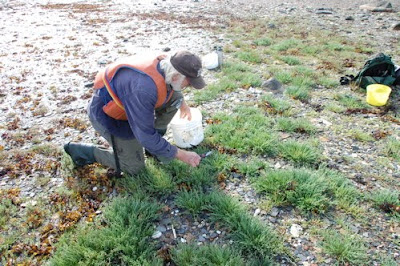
Chicken’s feet
CHICKEN’S FEET RELISH
(based on my mom’s zucchini relish recipe)
Chicken’s feet or sea glasswort (sea asparagus) is great raw in a salad. Add a can of kernel corn, sprouts if you have them, maybe some chopped carrot or celery or green or red pepper. Dress with oil, lemon juice and black pepper.

For relish, two ice-cream buckets of chicken’s feet makes about ten 250 ml jars.
Make the sauce by mixing 2 tablespoons of tumeric with one tablespoon dry mustard, 3 tablespoons dried celery leaf (half that if using commercial celery seed), one and half cups of sugar and 4 cups of vinegar. Add 6 tablespoons of cornstarch made into a paste with a bit of water.

Simmer the whole thing until it thickens, then add the chicken’s feet until tender. Don’t over cook! Hot pack in sterilized jars (see pickled fish recipe above re reusing lids and rings).

Seafood sauce & pickled ginger

SEAFOOD SAUCE
Mix ketchup (my dad used Heinz chili sauce) with horseradish to taste (2 to 1? depending on the strength of the horseradish). Creamed horseradish doesn’t work as well as plain. Add a liberal dash of Worchester sauce and another of lemon juice. Keeps for several weeks.

PICKLED GINGER
(son Eric got this one, years ago, off the internet)
A highlight of a trip on La Sonrisa is sushi night. A highlight of sushi night is home-made pickled ginger.

Peel ginger (you don’t have to be too particular) and slice as thin as possible. Toss with a tablespoon or two of coarse salt. The ginger will start to wilt, losing its juices. When limp and pliable, rinse in fresh water and then, a handful at a time, gently squeeze dry. Place in a bowl.

Prepare brine: 1¼ cup of rice vinegar (if you have it, otherwise any vinegar will do) to ½ cup of sugar and a pinch of salt. Bring to a boil to dissolve sugar. Cool. Pour over ginger, stirring so that all the ginger comes in contact with the brine. Pack in clean jars. Ready in 2 or 3 days.


Seafood harvest, buckets left to right: clams, prawns, crab, oysters
OYSTERS SONRISA
Steam oysters open, cool and shuck. Place oysters on the half shell on a cookie sheet (double up on the shells where you can). For Oysters Sonrisa Port, spoon on some salsa and sprinkle with grated cheese. For Oysters Sonrisa Starboard, spoon on some pesto and, again, sprinkle with grated cheese (feta is wonderful with pesto). Brown in oven until cheese melts.

Young nettles
For a make-your-own pesto out of nettles, chickweed, parsley, or whatever is abundant, see the link below. Walnuts can be substituted for pine nuts.

http://www.youtube.com/watch?v=d1nD9aDNX-k&feature=related

FLOUR-EGG-FLOUR OYSTERS OR FISH
Steam oysters open, cool and shuck. With frying pan on medium heat and a bit of oil, dip oysters in flour, then egg, then flour again. Fry till golden brown.

We use this recipe, also, for filets of any kind of white-fleshed fish, including halibut. Great with seafood sauce (above) or a dill-yogurt dressing (as follows).

DILL-YOGURT DRESSING
My favourite salad-dressing and/or dip. Mix yogurt with mayonnaise (maybe 2 to 1; wetter for a dressing, stiffer for a dip), add a dash of lemon juice and lots of dried dill. Even better made with yogurt that is getting a bit tart (i.e. old!)

This cole slaw with sprouts is dressed with dill-yogurt dressing.